

Wonder Why Your Yard Keeps Slowing Down? (It’s Not Just About Operations)
How a smarter pavement strategy improves throughput, reduces disruption, protects product, and lowers long-term cost.

By: Troy Kaiser
Senior Consultant
In warehousing environments, performance is measured in truck turns, dock velocity, and throughput.
But there’s a hidden constraint most operations teams aren’t actively managing: the condition and design of your pavement.
When pavement begins to fail, it rarely shows up as a “pavement problem.” Instead, it shows up as:
- Slower truck movement
- Congested yards
- Workarounds for drivers and operators
- Product damage
- Driver fatigue
- Increased safety risks
Eventually, it shows up as a disruption to your ability to meet customer expectations.
Most facilities don’t connect these dots until the problem becomes urgent. By then, options are limited, costs are higher, and disruption is unavoidable.
The Real Problem: Reactive Pavement Management
In many warehouse networks, pavement is managed reactively:
- Potholes get patched
- Failed areas get repaired
- Projects happen only when conditions become severe
On the surface, this feels efficient - fix what’s broken and move on. But over time, this approach leads to:
- Repeated spending in the same areas
- Increasing disruption to operations
- Unpredictable capital needs
- Shortened pavement life
And most importantly:
A yard that becomes harder to operate efficiently as it ages.
A Different Approach to Consider: Build Once, Maintain Strategically
There’s a better way to think about pavement, especially in high-traffic logistics environments.
Instead of repeatedly fixing surface issues, many organizations are shifting to a long-term pavement system approach by building a strong, durable foundation once, then maintaining the surface in planned, low-disruption cycles.
This approach is often referred to in engineering/consulting as a “perpetual pavement system”. This means that:
- The foundation and lower layers are designed to handle long-term traffic demands
- The surface layer is designed to be replaced periodically before major failure occurs
A perpetual pavement system allows your pavement to perform for decades, avoiding the high cost and extended disruption of a full-depth reconstruction.
What is Perpetual Pavement?
The concept of perpetual pavements was introduced in 2000 by the Asphalt Pavement Alliance (APA). They defined a perpetual pavement as “an asphalt pavement designed and built to last longer than 50 years without requiring major structural rehabilitation or reconstruction and needing only periodic surface renewal in response to distresses confined to the top of the pavement” (APA, 2002).
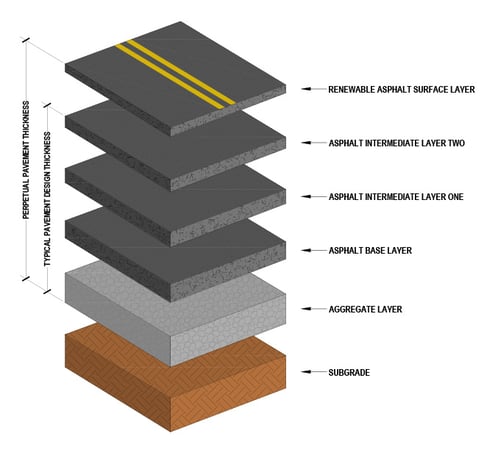
Perpetual Pavement Design Philosophy.
Why This Matters for Warehousing Facilities
This strategy isn’t just about pavement; it’s about operational performance.
Throughput Stays Consistent
A well-designed pavement structure supports:
- Smooth truck flow
- Efficient trailer movement
- Reduced congestion
- Less product damage
- Less driver fatigue
Instead of reacting to failures, maintenance of the yard consistently supports operations.
Disruption Becomes Planned (Not an Emergency)
Reactive repairs often happen at the worst possible time. With a long-term approach:
- Surface work is planned proactively
- Work can be scheduled around operations
- Downtime is shorter and more controlled
Peak Season Risk Is Reduced
Timing matters as much as condition. A failure during peak season can:
- Slow throughput
- Impact labor efficiency
- Put client commitments at risk
Planned maintenance significantly reduces the likelihood of high-impact failures at the wrong time.
Capital Spending Becomes Predictable
Instead of large, unexpected reconstruction projects:
- Costs are spread over time
- Investments are planned and justified
- Sites can be compared and prioritized consistently
This is especially important for organizations managing multiple facilities across a network.
The Role of the Foundation (and Why It’s Often Overlooked)
Most pavement failures don’t start at the surface; they start below it. Pavements, whether asphalt or concrete, are only as good as the base they are built on.
In heavy-duty environments like warehouses and distribution centers, trailer loads, constant turning movements, and repetitive traffic patterns place significant stress on the pavement system.
Without a properly designed foundation:
- Surface repairs won’t last
- Failures will repeat
- Costs will compound over time
A strong, dry foundation, combined with the right pavement structure, allows the surface to be maintained, not rebuilt.
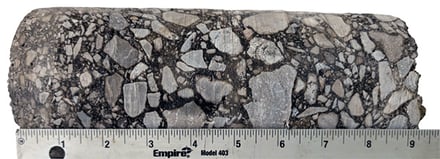
Multiple Asphalt Lift Core Sample.
The Cost Reality: Short-Term Savings versus Long-Term Performance
It’s common to prioritize lower upfront cost when making pavement decisions.
But in practice:
- Repeated repairs compound quickly
- Reconstruction creates major disruption
- Reactive decisions limit your options
By contrast, a long-term pavement strategy:
- Reduces total lifecycle cost
- Protects the initial investment
- Minimizes operational disruption
- Extends the usable life of the yard
Planned resurfacing or structural overlays cost significantly less than a full reconstruction and avoid the operational impact that comes with the significant downtime to fully rebuild a failed pavement.
What This Looks Like
Organizations that manage pavement effectively typically:
- Evaluate conditions portfolio-wide
- Prioritize work based on risk and operational impact
- Align maintenance and capital planning
- Implement multi-year strategies instead of one-off fixes
- Utilize the right rehabilitation method at the right time
Summary
Your pavement is more than a surface; it’s a critical part of your operational system.
When it’s managed reactively, it creates:
- Inefficiencies
- Risk
- Unpredictable cost
When it’s managed strategically, it supports:
- Throughput
- Safety
- Long-term performance
The goal isn’t only longer-lasting pavement; it’s a yard that works the way your operation needs it to, day in and day out.
Have questions about how to start a pavement management program and/or want to learn more about the benefits of a perpetual pavement system? Contact us.