

Many building owners still rely on a “run‑to‑failure” approach to roof management: install a roof, ignore it, repair leaks as they appear, and eventually replace it.
While this passive strategy may seem simple, it becomes problematic when rooftop photovoltaic (PV) systems enter the picture.
As low‑slope roofs increasingly serve as platforms for solar arrays, owners must make more deliberate, informed decisions. Solar investments are financially driven, and the condition and remaining life of the roof directly affects feasibility, long‑term performance, and return on investment.
Ideally, a new solar array is installed over a new, durable, “solar‑ready” roof with a service life aligned to the PV system’s 25‑year lifespan. In practice, however, solar installations are often planned without adequate consideration of roof age, condition, or suitability. This can lead to premature roof failure, costly system removal and reinstallation, and avoidable operational disruptions.
Below are four case studies illustrating common scenarios and Benchmark’s recommended strategies.
Case Study #1: Resort Hotel
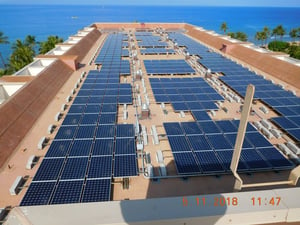
A rooftop PV installation was proposed at a large resort hotel, which is serviced by eight-year-old modified bitumen roof systems. The roofs were performing well but had developed light surface cracking because of high ultraviolet (UV) loading and tropical heat. The underlying “bones” of the roofs were sound, but our assessment determined that the roof membranes would not be capable of performing for 25 additional years to match the PV system lifespan. Less than ten additional years of service was anticipated, especially without addressing the surface deterioration.
The three basic roof management options included “run-to-failure,” roof replacement, or coating the membrane to correct/abate the surface deterioration. Running-to-failure would require removal and re-installation of the solar array, we estimated, less than ten years from the date of the PV system’s installation. Conversely, reroofing was premature and unnecessary.
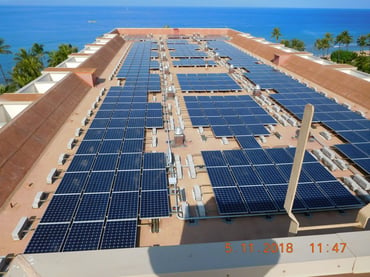
Solar panel installation can limit accessibility for repairs.
Our recommendation was to resurface the roof with a Poly methyl methacrylate (PMMA) coating prior to installing the solar array. The coating was intended to provide protection against further UV deterioration and extend the roofs’ life expectancy beyond the “run-to-failure” approach. Performance of the coated roofs was not expected to equal the 25-year solar panel lifespan, but we considered this approach would defer the roof replacements long enough to justify the cost of coating.
Case Study #2: Shopping Center
A 400,000‑square‑foot center already had solar panels covering 35% of its roofs. The 15‑year‑old modified bitumen systems showed granule loss, cracking, blistering, and scattered wet insulation.. Benchmark was retained to conduct a roof evaluation, which noted loss of surfacing granules, membrane surface cracking, and system-wide blistering of the top membrane ply. Our infrared scan also showed numerous random areas of wet insulation throughout the roofs.
We concluded that reroofing was not immediately required but should be anticipated within 5 to 7 years with continuation of the typical “run-to-failure” roof management approach.
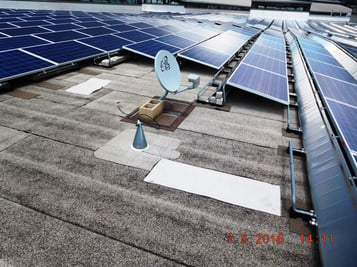
Imposing a solar array on an older roof is inadvisable due to eventual reroofing need.
Many of the roof sections on the shopping center are landlocked, with poor access for future construction. The building’s geometry, with multiple roof levels, tall area dividers, and poor construction access would collectively drive up the eventual reroofing costs. Reroofing would also disrupt solar energy production, a cost that would need to be absorbed by the building owner. Removal and reinstallation of the solar array would be complicated and costly, due to the same logistical factors affecting the roofing work.
A proactive roof “restoration” approach was recommended. The process included widespread membrane blister repairs, spot removal, replacement of wet insulation areas, and installation of an elastomeric coating system. Like Case Study #1, the coating was intended to address the surface deterioration and improve the future UV and heat resistance of the exposed roof areas.
While the preference would have been to coat the entire roof surface, we felt the cost of coating under the difficult-to-access solar arrays was neither necessary nor cost effective. In this case, the coating was recommended at the exposed membrane areas between solar panels and extending under the edges. The shaded areas under the array would not be as susceptible to future UV deterioration as the exposed square footage and could therefore be omitted. This restoration project was far less expansive and disruptive than reroofing and did not require interruption of the existing PV system.
Case Study #3: Resort Hotel
A resort with a 2012 TPO roof (20‑year warranty) sought evaluation before adding solar. The roof was performing well but had punctures, scratches, and minor damage.
Benchmark found the TPO roof system to be performing well, with no visible effects of weathering. However, the roof had a fair amount of “dings and dents,” scratches in the membrane, and several membrane punctures. We also identified the roofing manufacturer and the warranty information, which the resort’s management was not aware.
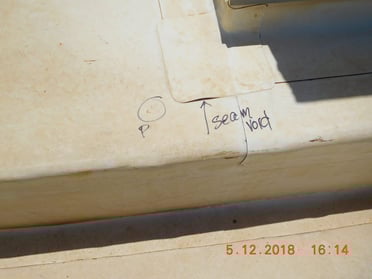
Preparing a roof to accept a new solar array includes repairing any roof membrane defects
Benchmark recommended that all current membrane punctures and scratches be repaired to an “as new” condition prior to installing the new solar array. This would also allow the facility to “turn over” their roof to the PV contracting team in an “as new” condition. Any subsequent damage would then be the responsibility of the solar installer to correct.
We also recommended that the facility requires the contracting team to use a manufacturer-approved roofing subcontractor to install the new TPO membrane flashings required to detail the many new PV system penetrations. The solar installer would also be required to arrange and pay for a follow-up inspection by the roofing manufacturer’s technical representative. Further, the installer would be required to provide any corrective work identified by the manufacturer, to ensure that the TPO roof warranty coverage would not be jeopardized.
Case Study #4: Warehouse Facility
This facility had a ballasted PV array installed when the existing 48-mil mechanically fastened PVC roof system was approximately 15 years old. That was 9 years ago, and the roof is now 24 years old. As the roof membrane has aged, deficiencies and associated leaks have developed. Repairs have generally been effective where the roof was accessible; however, finding, and correcting deficiencies have proven exceedingly difficult where the roof was inaccessible under the arrays.
This roofing dilemma could have been anticipated. The roof was nearing the end of its service life, but the solar array was in the middle of its service life. Leaks are a certain business disruption, but next to impossible to correct. Reroofing was clearly justified, but the associated cost was remarkably high due to the solar-related challenges.
The client asked for our opinion of the potential success and usefulness of coating the areas under the PV arrays, an attempt to plug leaks and forestall reroofing. While we have coated PVC membrane roofs in the past to provide short term correction of hail damage, we felt the physical challenges of working under an operating PV array would be problematic. Coating a PVC roof (and most other roof types) requires the roof surface to be clean – to allow for proper bonding of the coating. Perhaps an inventive contractor could devise a method to clean and coat, but we felt it was likely to be an unworkable solution.
Miscellaneous Factors
As rooftop solar becomes more common, several recurring issues have emerged:
-
Debris accumulation: Low‑profile, ballasted systems often trap debris and vegetation, affecting drainage and roof performance.
-
Bird activity: In coastal areas, solar panels can attract roosting birds, leading to panel soiling and additional roof cleaning needs.
-
Structural and wind considerations: Added loads and wind uplift forces must be evaluated to ensure long‑term performance.
-
Membrane wear: Ballasted arrays can shift or vibrate in wind, causing abrasion and membrane damage.
A successful solar installation requires a clear understanding of the existing roof system, its condition, and its suitability for long‑term service. Failing to evaluate these factors increases financial risk and can compromise both roof and PV performance.
By Jeff Evans, RRC (retired)