

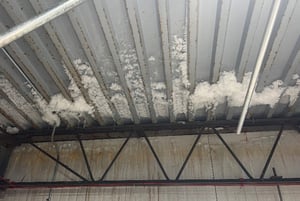
There are three main contributors: infiltration, conductance, and saturation, to condensation in refrigerated processing and cold storage operations. We will take a look at how roof systems must be designed to handle the unique challenges posed by penetrations and terminations, continuous low temperatures, high humidity differentials, and the need for airtight enclosures. Practical insights will be shared on best practices for selecting materials that resist thermal bridging and moisture, as well as techniques for proper installation to ensure long-term roof system performance and durability.
 By: Jennifer Stephan, RRC, CDT, ICC Building Inspector; and John Sutton
Condensation, along with the typical resulting active water or ice accumulation, food safety concerns, and steel corrosion in industrial facilities with refrigerated and cold storage operations, is often linked to roof system performance. Based on a study of leaks, roof and wall repairs, and roof system replacements over the span of 30 years in the industrial food manufacturing industry, condensation was identified as the primary cause for many of the reported leaks and system failures, particularly when the roof system was a component of the refrigerated enclosure.
Refrigerated processing and cold storage areas are conditioned to maintain an internal design temperature below 50ºF (10ºC) with some areas designed as low as -50ºF (-45ºC). Condensation forms when moisture-laden air contacts a building material with a surface temperature at or below the dew point temperature. There are three main contributors to condensation in these cold interior environments: infiltration, conductance, and saturation. Each source of condensation is distinctly different.
Condensation Caused by Infiltration
Infiltration occurs when enclosure transitions are not fully sealed against air and vapor movement. Through vapor drive, warm, moist air traveling through roof-deck-to-wall transitions or roof penetrations from the outside or adjacent environment mixes with the refrigerated cold interior air, causing condensation on steel surfaces as the temperature equalizes (or lowers) to the dew point. While vapor drive for most climate zones and occupancy types typically occurs from the inside to the outside, it is the opposite for refrigerated buildings. Infiltration in cold storage environments is exacerbated by significant air pressurization differentials. The mechanical cooling needed to maintain the interior temperatures often creates a negative pressure environment within the cooler or freezer, which draws air through gaps in the enclosure. Additionally, because cold air is heavier than warm air, the air movement within the refrigerated space, from the ceiling toward the floor, contributes to the pull of air through any gaps in the enclosure. For most freezers, and especially those in the southern half of the United States, the outside air is warmer than the inside air of the freezer. Because the cold air within the freezer space contains significantly less moisture than the outside air, “the cold air within the building wants to wring the water out of the air entering from the outside,” leading to active water and ice accumulation.1
Condensation from infiltration is most often observed as ice or icicles forming along the wall-to-deck transition at the interior or in the flutes of a steel roof deck within the roof system as seen in Figure 1 below. The condensation from infiltration presents on the cold side of the assembly as the air is drawn from warm to cold and moisture is released.
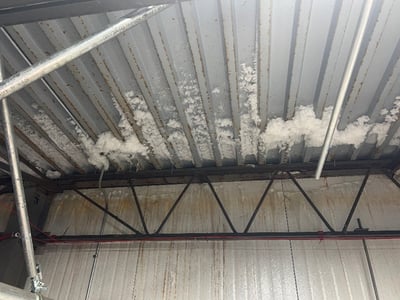
Figure 1 – Ice accumulation from roof-deck-to-wall transition.
Infiltration can also be caused by the typical operation of the cold storage area. Mass infiltration occurs at openings between cooled spaces and semi-cooled or unconditioned spaces. Even when interior or exterior doors are programmed or electronically controlled to automatically open and close for forklift or pedestrian traffic, the small bursts of cold to warm air caused during the use of the doorway contribute to condensation on steel surfaces directly inside the doorway as evidenced in the food manufacturing plant shown in Figure 2 below. Mass infiltration is exacerbated when the operational controls are overridden to allow the door to be kept open for prolonged periods of time.
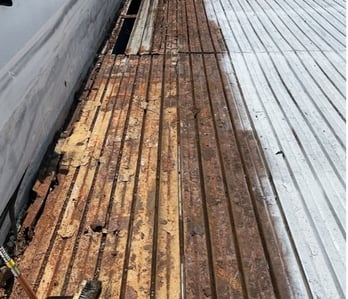
Figure 2 – Severe deck corrosion directly adjacent to interior doorway from warm to cold area.
The infiltration of warm, moist air causes strain on the mechanical cooling equipment and can lead to microbial growth, production downtime, and even product loss. Infiltration, whether through poorly sealed transitions or mass infiltration, was identified as the most likely source of condensation in most of the system failures.
Condensation Caused by Conductance
Conductance is another source of condensation in industrial refrigerated spaces. Conductance will occur when a building material, such as a steel structural member, passes continuously from a cold conditioned area through a wall or roof deck into a warm or unconditioned area. Where the cooled material encounters the warmer air outside of the refrigerated area, condensation will occur whenever the temperature at the surface of the material falls below the dew point. This often occurs at structural steel beams, roof joists, and insulated metal panel (IMP) skins that travel continuously through both a cold and warm space. Steel all-thread suspended ceiling panel support rods above freezer areas are another location where condensation and resulting corrosion often occur where the support rod travels from the cold freezer into the warm interstitial space.
Conductance is often thought to be the cause of many enclosure system failures; however, it actually occurs far less frequently. Condensation from conductance is typically localized and relatively easy to distinguish. Condensation from conductance will always be seen on the warm side.
Condensation Caused by Saturation
The third source of condensation in industrial refrigerated spaces is saturation, where the dew point in an area is close to the interior temperature. Condensation due to saturation is observed with widespread surface condensation or ice presenting on walls, ceilings, and/or the roof structure as seen in the cold storage facility shown in Figure 3 below. Saturation typically occurs for short periods during maintenance activities or when mechanical systems malfunction. Seasonal changes in the outdoor relative humidity may also create conditions that contribute to saturation.
Saturation provides the most obvious recognizable signs of condensation within the interior environment with widespread moisture or ice; however, it is the least frequent cause of enclosure system failure. Saturation is most often able to be controlled by mechanical or operational procedures.
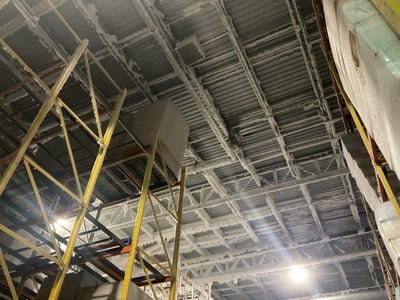
Figure 3 – Ice accumulation on the steel decking and steel framing members caused by saturation.
Discussion
With air infiltration identified as the most common cause of reported leaks to the interior and system failure in industrial refrigerated spaces, the discussion below will focus on methods and materials for prevention and mitigation of infiltration when the roof system is a component of the refrigerated space in both new construction and reroofing situations. It should be noted that there are many situations where facility operators will report condensation as a “roof leak” that often has nothing to do with the roof.
Air barrier seals play a critical role in maintaining temperature control, energy efficiency, and overall performance in refrigerated facilities. In these specialized environments, where temperature differentials are extreme, a well-installed air barrier system between conditioned and unconditioned components (occupancies or spaces) is essential to prevent moisture intrusion and potential system failures. More moisture is transported via air movement than by diffusion or any other means; simply stopping the air movement will stop moisture migration and the resulting condensation.
Close attention must be given to roof-to-wall transitions, cold-to-warm area divider walls (changes in designed temperature/occupancy below as shown in Figure 4 for example), mechanical equipment penetrations, and parapet walls. The air barrier material must be installed to prevent air movement from vapor drive and/or operational pressures. Even though the condensation from infiltration presents at the cold side, the optimal (and arguably the only) placement for the air barrier seal is on the warm side at the location of the pressure boundary, or the point of infiltration. Typically, in a roof system over refrigerated space, this boundary is at the surface of the roof membrane to the adjacent walls or penetrations and/or at the termination of the roof membrane at the exterior wall as shown in Figure 5.
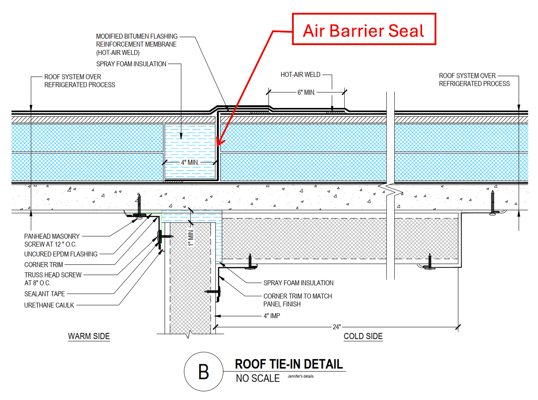
Figure 4 – Cold to Warm Transition in Occupancy with Air Seal In Roof Above
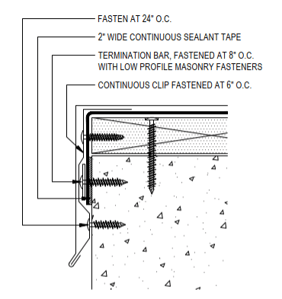
Figure 5 – Roof Membrane Sealed Termination at Exterior Face of Concrete Parapet Wall
Improper placement will create a host of other problems. The air barrier seal must both prevent outside air from entering the refrigerated interior and keep interior cold air from being drawn through the roof or wall assembly. The goal is to prevent warm air infiltration and the moisture that it introduces. The temperature of the roof and wall components can be warm or cold, above or below the dew point; as long as no moisture is introduced, no condensation will form.1
The material used to create the air barrier seal must have an appropriate permeability rating for air (less than 0.02 L/(s*m2) in accordance with ASTM E 2178)and vapor (Class II with less than 1.0 perms in accordance with ASTM E 96), be continuous over the joint or transition, and be able to withstand normal anticipated building movement, temperature, and forces. The material must be durable, be flexible, and have the ability to conform to various shapes, components, and profiles. In truth, nearly every roof membrane can provide an effective air seal if detailed properly. Modified bitumen and single-ply membranes, such as ethylene propylene diene terpolymer, polyvinyl chloride, and ketone ethylene ester, installed in full adhesive, can provide long-lasting service. The edges of the air barrier membrane must be positively terminated to ensure it does not slip or become loose over time. Self-adhered membranes and reinforced liquid flashing systems may also provide successful performance, depending on the in-service temperature performance range provided by the manufacturer.
For many refrigerated spaces, the exterior wall systems include IMPs, masonry, or cast-in-place concrete. IMPs have tongue-and-groove side-lap vertical joints, as well as typically a fluted panel profile. The corner and vertical side-lap joints and flutes of the IMPs create chimneys for air transfer if not properly sealed. Continuity of the air seal is not only critical at the roof but also must work in conjunction with air seals at wall penetrations and vertical building corners.
Roof decking for many refrigerated spaces includes cold-formed steel roof decking, precast concrete panels, and IMPs. When the exterior wall extends beyond the roof deck or terminates flush with the top of the roof deck, the boundary between the cool interior and warm exterior is better defined and allows for the easiest air seal between the roof deck and the exterior wall (Figure 6).
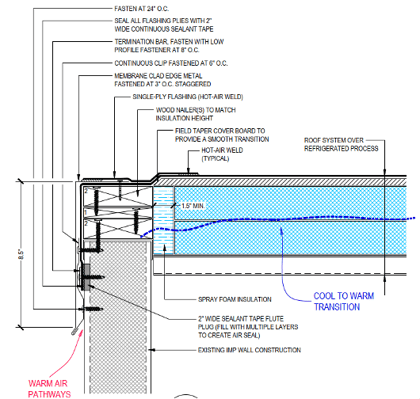
Figure 6 – Sealed Termination of Roof Membrane at Exterior Wall Face and Clear Boundary Between Cool Interior and Warm Exterior; Note Sealant Tape Within Flutes of IMP to Create Air Seal
One of the challenges with many industrial facilities is renovating and changing the use of spaces to adapt to the ever-changing market. Making changes to the interior design temperature within an industrial refrigerated facility can have a catastrophic impact on the overall performance of the roof and wall systems. Changing the occupancy from a freezer to a blast freezer, for example, can lower the designed interior temperature by as much as 30ºF. Without modification to the thermal insulation systems and a functional air seal, this occupancy change could easily result in condensation caused by infiltration and saturation.
Multi-wythe masonry walls with a traditional air gap present one of the toughest challenges in renovation and reroofing applications. In many older buildings, the interior wythe of the masonry wall was used to support the steel roof deck. This creates a very difficult condition to seal for a refrigerated interior space. The warm outside air drawn through the weeps or vents of the masonry wall through vapor drive travels up the chimneys inside the masonry wall created by the air gap between wythes and the integral holes of the masonry units funnels into the ends of the steel decking (Figure 7), where it condenses on the top surface of the steel deck and infiltrates through the flutes of the deck to the interior (Figure 8). This condensation occurs cyclically whenever the temperatures outside the refrigerated space are greater than the temperatures inside, which for many refrigerated facilities is the majority of the year. If left unchecked, the repeated condensation will lead to the structural failure of the steel decking panels and leave the roof prone to blowing off (Figure 9).
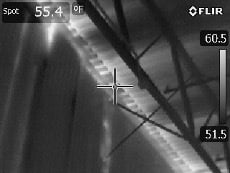
Figure 7 – Warm air infiltration noted at roof to wall termination within a cold storage facility.
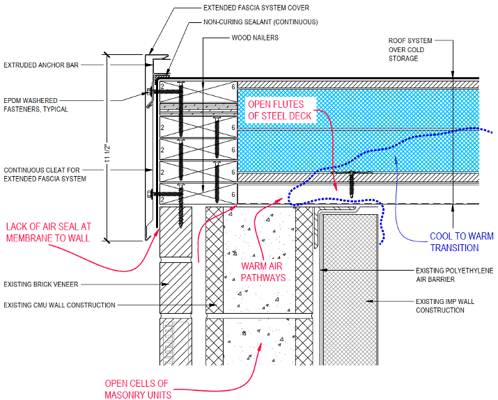
Figure 8 – Cold Storage Exterior Multi-Wythe Wall Without Proper Air Seal (Condition Prior to Blow Off Shown in Figure 7)
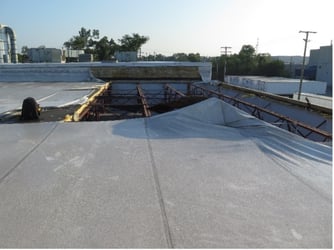
Figure 9 – Roof Blow Off Caused By Severe Deterioration of the Steel Decking Along Brick Parapet Wall
Although there are several ways to mitigate the air infiltration at this multi-wythe brick and IMP wall shown in Figure 8, the most effective method would either require fully sealing the exterior face of the brick wall, including elimination of any weeps or vents, or structural modifications to eliminate the brick ledge and support the ends of the steel deck at the face of the brick wall. This would allow for a clear and distinct boundary between cool and warm environments and allow for the placement of a functional air seal. Without a clear and distinct boundary for the air seal, it is possible to change the temperature and dew point to limit the occurrence of condensation as shown in Figure 10; however, full prevention will be next to impossible.
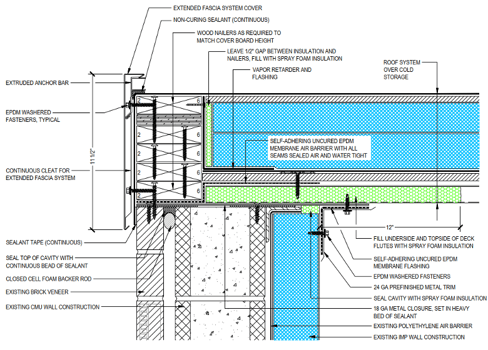
Figure 10– Cold Storage Exterior Multi-Wythe Wall Example With Multiple Measures to Create An Effective Air Seal
Thermal insulation plays a key role in helping to prevent condensation by changing the temperature of components to avoid the dew point. Inadequate thermal insulation will allow cyclical conditions that are prone to repeated condensation through the service life of the roof and wall components. For renovation projects, this may require supplemental insulation at either or both the cold and warm sides of the refrigerated space to control the temperatures. But as noted above, adding thermal insulation will not solve an infiltration problem.
In some cases, a vapor retarder layer may also serve as the air barrier within a roof assembly; however, for the majority of refrigerated spaces, the roof membrane itself acts as the air barrier and vapor retarder on the warm side of the roof assembly. As the first measure of protection against air infiltration, the roof membrane should be sealed to the exterior wall and at all penetrations as the primary air seal. Additional measures may be incorporated using spray polyurethane foam, but remember the more complex the detail, the less focus will be paid to the primary air seal. The secondary foam may actually delay seeing the failure, whereas if the design is simple, the success can be verified very quickly after installation, many times while the contractor is still on-site and invested.
Penetrations are often another source of infiltration, especially insulated piping penetrations. One of the most important components of refrigerated process piping is the continuous pipe wrap insulation and vapor barrier membrane. The pipe wrap is sometimes damaged or even stopped at the roof deck, which leads to air infiltration and often water intrusion into the roof assembly and space below. Ensuring that the pipe sleeve, insulation and vapor retarder membrane wrap remain in good condition and continuous through the roof system, past the decking, and into the interior, as shown in Figure 11, is critical to the performance of both the piping and the roofing systems. With a continuous sleeve through the full depth of the roofing system, the piping can be isolated from the roof system and roof system flashed watertight regardless of the performance of the piping insulation or wrap. Achieving an airtight seal for the roof then becomes possible with a standard flashing detail and sealing the annular space between the pipe sleeve and the pipe wrap or can be more complex with the construction of an isolation curb (Figure 12). In either case, sealing the roof membrane to the pipe sleeve or penetration curb is critical to preventing air infiltration and condensation within the roofing system.
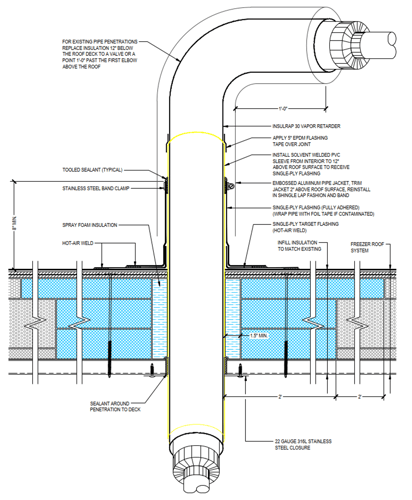
Figure 11 – Ammonia (Refrigerant) Piping Penetration Flashing Detail Showing Continuous Air and Vapor Barrier Protection At Pipe From Interior Through Roof Assembly.
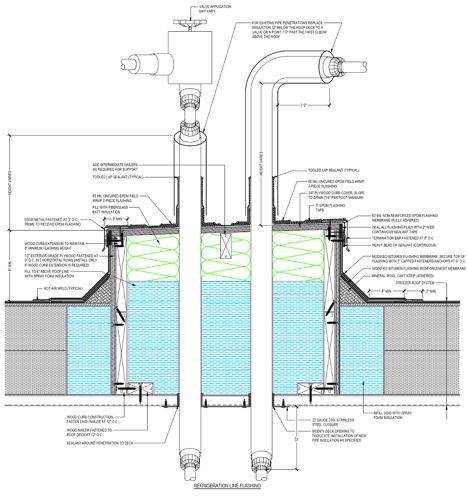
Figure 12. Isolation Curb Flashing Showing Spray Polyurethane Foam to Form Primary Air Seal At Ammonia (Insulated Refrigerant) Piping Penetrations
Conclusion
Once a functional air seal has been installed, a roof replacement has been accomplished, and the building is watertight, facility operators and owners carry the burden of maintaining this rather delicately balanced system. As mentioned above, although minor shifts in cooling temperatures may not immediately impact the overall balance of the system, abrupt changes, mechanical equipment deterioration, and changes in operational use can have drastic ramifications. Just as many food manufacturing plants emphasize and enforce good manufacturing practices, including procedures for maintaining the “cold chain,” similar good cold storage practices should be developed to provide clear operating guidelines that allow for optimal use of the interior space and optimal performance for the enclosure components.
Preventing and mitigating condensation, as well as the resulting leaks and damages, requires interdisciplinary coordination, beginning with the design and installation phase and continuing through the service life of the systems to ensure long-term performance. Discovering the source of condensation after installation often requires destructive investigation and analysis of the interior and exterior factors contributing to the condensation. Strategic repair and replacement strategies are necessary to achieve a fully functional air seal with ideal placement to prevent infiltration in refrigerated processing and cold storage facilities.
DOWNLOAD 
Reference
1 Wetherholt, Ray. 2015. “Considerations in Design and Construction of Freezer Buildings for Building Envelope Consultants.” Interface 33 (11): 22–26.